What Is a CBDC? Central Bank Digital Currencies Explained
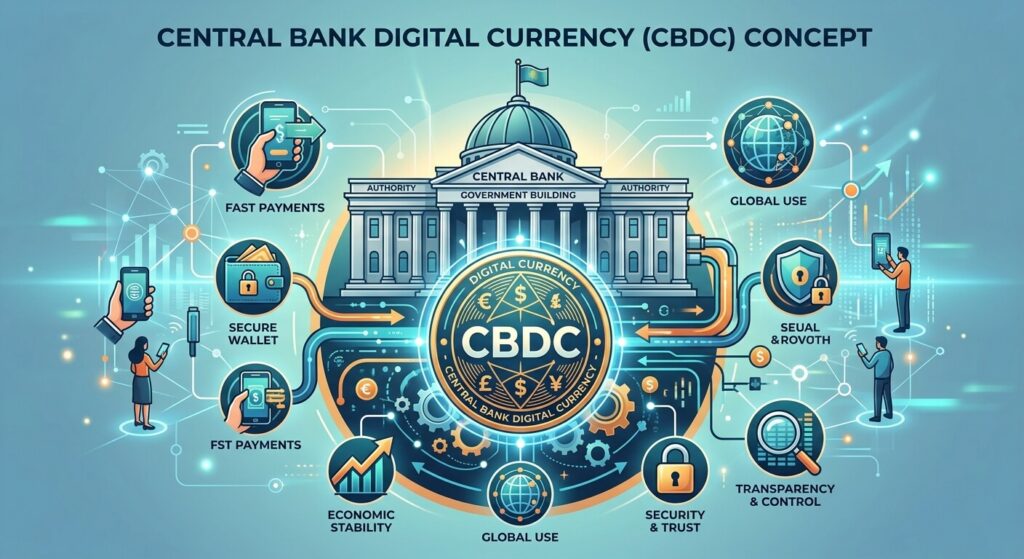
A Central Bank Digital Currency (CBDC) is a digital version of a country’s official currency, issued and backed directly by its central bank rather than by a commercial bank or private company. Unlike Bitcoin or other cryptocurrencies, a CBDC is centralized, holds legal tender status, and trades at a fixed 1:1 value with the country’s physical cash. As of 2026, only a handful of countries have fully launched one, while more than 130 others are researching, piloting, or building the infrastructure to do so.
What Is a CBDC, Exactly?
A CBDC represents a direct liability of the central bank — the same institution responsible for printing physical banknotes. That distinguishes it from the money already in your bank account, which is technically a liability of your commercial bank, not the central bank itself.
Three features define a CBDC:
- Government-issued and backed. It carries the full legal and monetary authority of the issuing country.
- 1:1 parity with national currency. One digital unit always equals one unit of physical cash — there’s no exchange rate or price fluctuation.
- Legal tender status. In countries where it’s fully launched, a CBDC must be accepted as a valid form of payment.
This is fundamentally different from decentralized cryptocurrencies like [INTERNAL LINK: What Is Bitcoin?], which have no central issuer, and from private stablecoins, which are typically issued by companies and backed by reserves rather than a government.
How Many Countries Have a CBDC in 2026?
As of mid-2026, only three countries have fully launched a retail CBDC: the Bahamas (Sand Dollar), Jamaica (JAM-DEX), and Nigeria (eNaira), according to the Atlantic Council’s CBDC tracker. All three continue to face slow domestic adoption — in Jamaica, for example, JAM-DEX still accounts for roughly 0.1% of the country’s total money in circulation.
That said, the broader trend is toward exploration, not launch:
- Over 130 countries and currency unions, representing nearly 98% of global GDP, are actively researching, piloting, or developing a CBDC
- All 11 BRICS members are exploring a CBDC, with nine already in pilot phase
- The United Arab Emirates launched a pilot of its Digital Dirham in late 2025
China’s e-CNY: The World’s Largest CBDC Pilot
China’s digital yuan, known as e-CNY, remains the largest CBDC pilot globally by a wide margin. By December 2025, retail e-CNY had processed more than 3.4 billion transactions worth an estimated 16.7 trillion renminbi — roughly $2.3 trillion — according to Atlantic Council data.
In January 2026, the People’s Bank of China reclassified e-CNY as a deposit liability, a technical shift that may signal a change from its original design as a direct substitute for physical cash. As of this writing, China has not clarified its long-term plans for the currency’s classification.
The Digital Euro: Where Does Europe Stand?
The European Central Bank has moved cautiously but steadily toward a digital euro pilot. Key milestones so far:
- The ECB published its call for pilot participants on March 5, 2026, and received more than 50 applications from payment service providers
- Backend technical specifications were released on April 23, 2026
- The outcome of participant screening is expected to be announced in July 2026
- A 12-month pilot is scheduled to begin in the second half of 2027
- If legislation is adopted, the ECB is targeting potential first issuance in 2029
The project isn’t cheap: the ECB estimates roughly €1.3 billion in development costs and €320 million in annual operating costs once launched.
Why Doesn’t the U.S. Have a CBDC?
The United States has taken the opposite approach from China and the EU. In January 2025, President Trump signed Executive Order 14178, prohibiting federal agencies from establishing, issuing, or promoting a CBDC, and ordering any related plans to be terminated immediately. The order cited risks to financial stability, individual privacy, and national sovereignty.
That policy position was written into law in mid-2026. The 21st Century ROAD to Housing Act, which became law on July 11, 2026, included a provision — championed by Senate Banking Committee Chairman Tim Scott and based on language from Senator Ted Cruz’s Anti-CBDC Surveillance State Act — that statutorily bans the Federal Reserve from issuing a digital dollar through December 31, 2030.
Supporters of the ban, including Cruz, have framed a retail CBDC as a potential surveillance risk, giving the federal government visibility into individual financial transactions. Some Democratic lawmakers, including Senator Elizabeth Warren, have previously described CBDCs more favorably, though the ban passed as part of a larger piece of legislation.
In practice, the U.S. ban shifts attention toward privately issued, dollar-backed stablecoins as the country’s preferred form of digital dollar — an approach reinforced by the GENIUS Act’s stablecoin framework, covered in our guide to [INTERNAL LINK: What Are Stablecoins?].
Cross-Border CBDCs: Projects Like mBridge
Beyond domestic retail use, central banks are also experimenting with CBDCs for cross-border wholesale settlement — transactions between banks and institutions, not everyday consumers. There are currently 13 such projects globally, more than double the number active before 2022.
The most prominent is mBridge, a multi-country wholesale CBDC platform. Transaction volume on the project has surged to $55.49 billion, a roughly 2,500-fold increase since its early pilots, with e-CNY accounting for more than 95% of total settlement volume on the platform.
CBDC vs. Cryptocurrency vs. Stablecoin — What’s the Difference?
These three terms get confused often, but they work very differently:
| Feature | CBDC | Cryptocurrency (e.g., Bitcoin) | Stablecoin |
|---|---|---|---|
| Issuer | Central bank (government) | No central issuer | Private company |
| Decentralized? | No | Yes | No |
| Backing | Full faith of the government | None (market-driven value) | Reserve assets (cash, bonds, etc.) |
| Legal tender | Yes, where launched | No | No |
| Value stability | Fixed 1:1 with national currency | Highly volatile | Designed to stay near $1 |
For a deeper look at how the other two work, see our guides on [INTERNAL LINK: What Is Bitcoin?] and [INTERNAL LINK: What Are Stablecoins?].
Potential Benefits and Risks of CBDCs
Potential benefits:
- Faster, cheaper domestic and cross-border settlement
- Greater financial inclusion for unbanked populations
- New tools for central banks to implement monetary policy directly
- Reduced reliance on private payment intermediaries
Potential risks:
- Privacy and surveillance concerns, since transactions could be traceable by the government
- Risk of disintermediating commercial banks if consumers move deposits directly to central bank accounts
- Slow real-world adoption even where CBDCs have launched, as seen in Jamaica and the Bahamas
- Significant infrastructure and development costs, as illustrated by the ECB’s multi-billion-euro digital euro budget
Frequently Asked Questions
What does CBDC stand for? CBDC stands for Central Bank Digital Currency — a digital form of a country’s official currency, issued directly by its central bank.
Is a CBDC the same as Bitcoin? No. Bitcoin is decentralized, with no central issuer and a value set entirely by the market. A CBDC is centralized, issued by a government, and pegged 1:1 to that country’s existing currency.
Does the United States have a CBDC? No. The U.S. banned federal agencies from developing a CBDC via executive order in January 2025, and that ban was written into law in July 2026, prohibiting the Federal Reserve from issuing a digital dollar through the end of 2030.
Which countries currently have a fully launched CBDC? As of 2026, three countries have fully launched a retail CBDC: the Bahamas (Sand Dollar), Jamaica (JAM-DEX), and Nigeria (eNaira).
Will CBDCs replace cash? Most central banks, including the ECB, have stated that a CBDC is intended to complement physical cash and existing electronic payments, not replace them outright.
Disclaimer: This article is for informational purposes only and does not constitute financial, investment, or legal advice. Global Crypto 360 does not endorse any specific asset, platform, or strategy mentioned. Always conduct your own research (DYOR) before making financial decisions.