Best Robo-Advisors of 2026: Fees, Minimums, and Features Compared
Compare the best robo-advisors of 2026 — Betterment, Wealthfront, Schwab, Vanguard, Fidelity Go, and Acorns — on fees, minimums, and features.
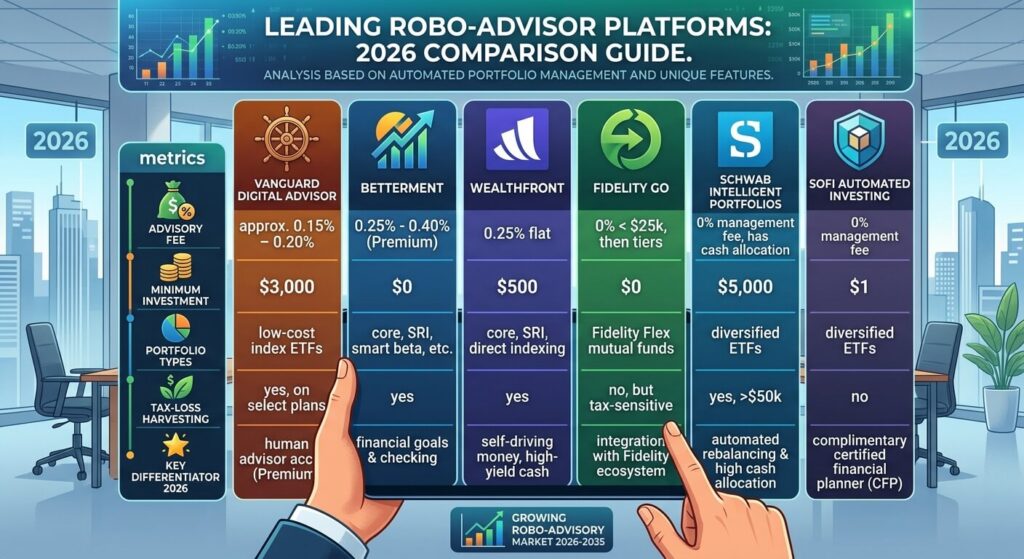
Six providers stand out among 2026’s robo-advisors for their combination of low costs, account flexibility, and track record: Betterment, Wealthfront, Schwab Intelligent Portfolios, Vanguard Digital Advisor, Fidelity Go, and Acorns. Each takes a different approach to fees and features, so the “best” choice depends on account balance, whether tax-loss harvesting matters, and whether an investor wants a percentage-based fee or a flat subscription. [For a full explanation of how the category works, see: What Is a Robo-Advisor?]
Key Facts
- Annual advisory fees among these six providers range from 0% (Schwab Intelligent Portfolios, Fidelity Go under $25,000) to roughly 0.15%–0.65%, with some providers charging a flat monthly subscription instead of a percentage.
- Account minimums range from $0 (Betterment, Fidelity Go, Acorns) up to $5,000 (Schwab Intelligent Portfolios).
- Tax-loss harvesting is available at Betterment, Wealthfront, and Schwab Intelligent Portfolios (the latter only above $50,000), but not at Vanguard Digital Advisor’s base tier or at Acorns.
- “Zero management fee” providers still carry indirect costs — Schwab through a mandatory cash allocation, Acorns through a flat fee that is proportionally higher on small balances.
Comparison Table
| Provider | Advisory Fee | Account Minimum | Tax-Loss Harvesting | Best For |
|---|---|---|---|---|
| Betterment | 0.25%/year (or $5/month under balance thresholds) | $0 | Yes, on taxable accounts | Beginners wanting a $0-minimum, full-featured platform |
| Wealthfront | 0.25%/year | $500 | Yes, plus direct indexing at $100,000+ | Larger taxable accounts seeking advanced tax optimization |
| Schwab Intelligent Portfolios | 0% stated fee | $5,000 | Yes, above $50,000 | Investors wanting no explicit advisory fee within Schwab’s ecosystem |
| Vanguard Digital Advisor | ~0.15%–0.20%/year | $100 | No | Low-cost, buy-and-hold retirement investing with Vanguard funds |
| Fidelity Go | 0% under $25,000; tiered above | $0 | No | Very small or beginner accounts wanting a zero-fee entry point |
| Acorns | $3–$12/month flat subscription | $0 to open ($5 to invest) | No | Investors who want automated “spare change” round-up investing |
Note on methodology: figures reflect provider disclosures gathered from provider and third-party review sources current as of mid-2026. Fees and minimums change; verify against each provider’s official pricing page before publishing or acting on this comparison.
What Is a Robo-Advisor? How Automated Investing Works
Betterment
Betterment charges a 0.25% annual advisory fee on accounts above certain balance or deposit thresholds, or a flat $5 monthly fee below them, with no required account minimum. It offers tax-loss harvesting on taxable accounts, automatic rebalancing, goal-based planning tools, and an optional higher tier with access to certified financial planners. Underlying fund expense ratios for its core portfolio run roughly 0.04%–0.11%. Betterment is generally positioned as a strong default choice for investors who want a fully automated platform without a minimum balance requirement.
Wealthfront
Wealthfront also charges a 0.25% annual fee but requires a $500 minimum to open an account. Its differentiator is tax optimization at scale: beyond standard tax-loss harvesting, accounts above $100,000 gain access to direct indexing, which holds individual securities that replicate an index to enable more granular, stock-level tax-loss harvesting. Wealthfront also offers automated bond laddering and broader self-directed options. It tends to be recommended for investors with larger taxable accounts who want to minimize tax drag over time.
Schwab Intelligent Portfolios
Schwab Intelligent Portfolios charges no stated annual advisory fee, which makes it an outlier among major providers. The trade-off is a mandatory cash allocation — typically in the range of 6% to 10% of the portfolio for moderate-to-aggressive risk profiles, and higher for conservative ones — held in a Schwab Bank sweep account that earns a bank savings rate rather than being invested in the market. Whether that structure is cheaper than an explicit 0.25% fee depends on prevailing interest rates and an investor’s risk profile: in higher-rate environments, the opportunity cost of the cash allocation can exceed what a percentage-fee competitor would charge. Schwab requires a $5,000 minimum and enables tax-loss harvesting only on accounts of $50,000 or more.
Vanguard Digital Advisor
Vanguard Digital Advisor charges an estimated net advisory fee of roughly 0.15%–0.20% annually and requires just $100 to open an account ($5 within an eligible 401(k)). Portfolios are built exclusively from a small set of low-cost Vanguard ETFs and rebalance automatically once the allocation drifts beyond a set threshold. It does not offer tax-loss harvesting or access to a human advisor at the Digital Advisor tier — investors wanting CFP access can step up to Vanguard’s separate Personal Advisor Services, which charges roughly 0.30% and requires a $50,000 minimum. Digital Advisor is generally positioned toward long-term, buy-and-hold retirement investors comfortable with an all-Vanguard portfolio.
Fidelity Go
Fidelity Go charges no advisory fee on balances under $25,000 and a tiered fee above that threshold, with no required account minimum to open (a small deposit is needed to begin investing). Its portfolios use Fidelity’s own zero-expense-ratio index funds at the lowest tier, and the platform offers optional access to Fidelity advisors depending on balance. It does not offer tax-loss harvesting. Fidelity Go is typically recommended for new investors starting with a small account who want to avoid fees entirely while their balance grows.
Acorns
Acorns departs from the percentage-fee model used by the other five providers, instead charging a flat monthly subscription of $3, $6, or $12 depending on the tier. There is no minimum to open an account, though $5 is required to begin investing. Acorns is built around automated “round-up” investing, in which purchases are rounded to the nearest dollar and the difference is invested automatically, alongside standard portfolio management and rebalancing. The flat-fee structure means cost as a percentage of assets is high on small balances — a $3 monthly fee equals roughly 7% annually on a $500 balance — and becomes proportionally cheaper as the account grows. Acorns does not offer tax-loss harvesting, and transferring investments out to another brokerage carries a per-ETF fee. It is generally positioned toward beginners who want a low-effort, automatic way to start investing small amounts consistently.
How to Choose
- If you want the lowest effective cost on a large taxable account: Wealthfront’s direct indexing at $100,000+ or Betterment’s 0.25% flat rate are the most competitive among fee-charging platforms.
- If you want to avoid an explicit advisory fee and don’t mind a cash allocation: Schwab Intelligent Portfolios, provided you can meet the $5,000 minimum.
- If you’re investing primarily for retirement and want the lowest-cost, simplest option: Vanguard Digital Advisor’s ~0.15%–0.20% fee and $100 minimum are difficult to beat for buy-and-hold investors.
- If you’re starting with little or no money and want a zero advisory fee: Fidelity Go under $25,000.
- If you want an automated nudge to save and invest spare change: Acorns, understanding that the flat fee is comparatively expensive on small balances.
Regulatory Note
All six platforms operate as SEC- or state-registered investment advisers in the U.S. and are subject to fiduciary obligations under the Investment Advisers Act of 1940. Registration status and disciplinary history for any provider can be verified through the SEC’s Investment Adviser Public Disclosure database via Investor.gov.
Frequently Asked Questions
Which robo-advisor has the lowest fees? Schwab Intelligent Portfolios and Fidelity Go (under $25,000) charge no explicit advisory fee, though Schwab’s mandatory cash allocation is an indirect cost worth factoring in. Among providers with an explicit percentage fee, Vanguard Digital Advisor’s roughly 0.15%–0.20% is the lowest of the six compared here.
Which robo-advisor is best for beginners? Betterment and Fidelity Go are commonly recommended for beginners because both have no required account minimum. Acorns is also popular with beginners for its automated round-up investing, though its flat fee is proportionally higher on small balances.
Do any of these robo-advisors offer tax-loss harvesting? Betterment and Wealthfront offer it on taxable accounts without a balance requirement. Schwab Intelligent Portfolios offers it only above a $50,000 balance. Vanguard Digital Advisor, Fidelity Go, and Acorns do not offer it.
Can I use a robo-advisor for a Roth IRA? Yes. All six providers compared here support IRAs, including Roth IRAs, applying the same automated allocation and rebalancing within the applicable tax rules.
Is a $0 advisory fee actually free? Not necessarily. Schwab Intelligent Portfolios’ zero fee comes with a mandatory cash allocation that earns a bank sweep rate rather than market returns — an indirect cost known as “cash drag” that can, in some environments, exceed what a percentage-fee competitor charges.
Disclaimer: This article is for informational purposes only and does not constitute financial, investment, or legal advice. Global Crypto 360 does not endorse any specific asset, platform, or strategy mentioned. Fees, minimums, and features are subject to change; verify current terms directly with each provider. Always conduct your own research (DYOR) and consult a licensed financial professional before making financial decisions.